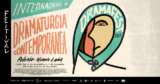
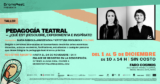
Dramaturgy workshops led by Artur Pałyga and theatre pedagogy workshops conducted by Maria Babicka-Janiszewska and Krystyna Mogilnicka were held in Mexico City and Monterrey during the DramaFest International Festival of Contemporary Drama, and were met with an enthusiastic reception. One outcome was the formation of informal groups focused on dramaturgy and theatre pedagogy.
DramaFest in Mexico is one of the region’s most significant festivals devoted to contemporary theatre and dramaturgy. It serves as a platform for cultural exchange and collaboration between Mexican and international artists. Every two years, artists from Mexico meet theatre creators from a selected country to familiarise themselves with existing works, co-create new projects, and exchange theatrical know-how.
In 2025, the focus was on Poland, which is renowned for its contemporary theatrical tradition characterised by robust political and social engagement. This tradition deeply resonated in Mexico during the second half of the twentieth century. A key component of the festival was the exchange of knowledge and experience through dramaturgy workshops led by Artur Pałyga and theatre pedagogy workshops conducted by Maria Babicka-Janiszewska and Krystyna Mogilnicka. The workshops attracted considerable interest, with participants forming a highly diverse group in terms of both age and experience. In both Mexican cities, workshop participants emphasised the limited opportunities for developing playwriting skills and found the principles of theatre pedagogy for working with groups of amateurs and professionals in universities and schools very inspiring.
The participating playwrights worked on texts that incorporated elements of magical realism alongside direct references to challenging social issues. “For several hours a day, we talked about writing, the precarious situation of theatre practitioners in Mexico and life and death in this country. A recurring theme was the search for alternative, non-realistic ways of constructing narratives. The participants were very interested in Polish theatre and dramaturgy, and emphasised how much they lacked such workshops. I encouraged them to meet independently, support one another as writers, read each other’s work and discuss it together. Immediately after we left, the Monterrey group informed us that they had set up an informal local association of playwrights – a direct result of the workshop discussions. I am very pleased about this”, says Artur Pałyga. In Mexico City, he was accompanied by translator Anna Solska, and Oskar Casanova acted as interpreter from English during the workshop in Monterrey.
During the theatre pedagogy workshop, participants familiarised themselves with the field’s principles through practical exercises accompanied by theoretical commentary on Polish experiences and the subject more broadly. The activities focused on creating a performance with a group without a supporting drama and on working with an audience. Participants took part in a workshop related to the performance Entre Nosotros Todo Va Bien (No Matter How Hard We Tried) by Dorota Masłowska, directed by Diego del Río and translated by Pau Freixa Terradas. They ultimately designed and led parts of their own workshop for the group. As well as practising theatre pedagogy, they shared experiences from their own pedagogical work in theatre. “Meeting with theatre practitioners in Mexico showed us that theatre pedagogy functions effectively as a Polish ‘export product’. By combining our experience with the participants’ working contexts, we discovered the universality of its principles and methods. Balancing the importance of the group process with the creative process when working with amateurs was inspiring for those who work daily with professionals as well. The model of a performance-based workshop emerged as an entirely new way of thinking about working with theatre audiences, and similar workshops are already being planned in Mexico. Beginning the work with the theme of play and carefully discussing experiences was crucial for forming both groups and ensuring the success of the workshops”, said Maria Babicka-Janiszewska on behalf of the workshop leaders. The workshops were conducted in English, and interpretation into Spanish was provided by the young theatre artist Jatzke Cervantes. They were accompanied by a Spanish-language selection of three texts from the publication Praktykując pedagogikę teatru. Pojęcia, wartości, przykłady (Practising Theatre Pedagogy: Concepts, Values, Examples), published by the Institute in 2024 and supplemented with additional commentary for international readers. A selection of texts was also published in English.
Skip to PDF contentFeedback from participants:
“I’m very grateful for the workshop, I learned so much”.
“Your work is so beautiful, keep doing it. It’s a very human vision that we need in the world today”.
“Your patience and clarity in the processes were very meaningful, also that in every clue was evident the connection between all the stages of the workshop”.
“I really enjoyed the workshop because it gave me a clear methodology about theatre pedagogy. I think you had a balance between listening and practising. In a lovely and respectful way. Thanks for your generosity and for giving me a new perspective. I hope I’ll find you in Poland or here in Mexico”.
In Mexico City, the workshop was held in FARO Cosmos and the Centro Cultural El Rule, and in Monterrey, in the Teatro de la Ciudad municipal theatre. The producers of the workshops on the part of DramaFest were Omar Flores López, Joshua Varela, and Fryda Vázquez.
The “Polish Focus” at the DramaFest was co-organised by the Zbigniew Raszewski Theatre Institute, Cero Varo in Mexico, and the Adam Mickiewicz Institute. The event partner was the Jan Kochanowski Theatre in Opole.
The Adam Mickiewicz Institute (AMI) brings Polish culture to people around the world. Being a state institution, it creates a lasting interest in Polish culture and art through strengthening the presence of Polish artists on the global stage. It initiates innovative projects that support international cooperation and cultural exchanges. It promotes the work of both established and promising artists, showing the diversity and richness of our culture. The Adam Mickiewicz Institute runs the Culture.pl website, a comprehensive source of knowledge about Polish culture. For more information, visit: www.iam.pl.
The project was co-financed by the Ministry of Culture and National Heritage of the Republic of Poland as part of the Polish programme at the DramaFest International Festival of Contemporary Drama in Mexico.