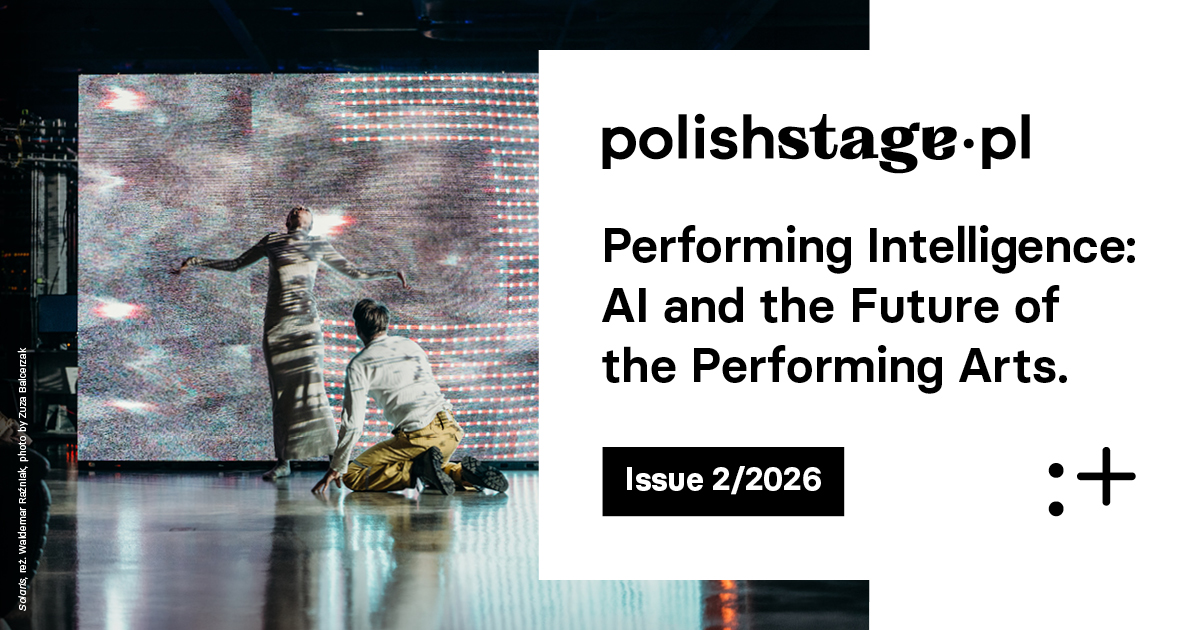
In the second issue of the English-language magazine polishstage.pl, entitled Performing Intelligence: AI and the Future of the Performing Arts, we don’t ask whether artificial intelligence will transform theatre. The change is already happening. The question is what shape theatre will take after this change. Will AI merely expand stage language as another tool, or will it be a technology that, under the guise of democratising creativity, brings new forms of control, precarisation, and the standardisation of imagination?
At the turn of the 21st century, researchers and theorists heralded the arrival of a new era in which the world would be inhabited by intelligent cyborgs and human consciousness would be liberated from its biological form to exist in a digital cloud. While many of these predictions have yet to be realised, we are undoubtedly on the verge of a turning point in civilisation whose significance may be even greater than that of the Industrial Revolution. The consequences of the digital revolution will affect every area of human activity, including artistic creation. Artificial intelligence has crept into theatre unnoticed, first as a theme, then as a tool and finally as a promise that text can be written more quickly, set designs can be generated, and images, voices, and figures can be created. Perhaps even some of the work previously performed by humans can be replaced. Theatre, by definition an art of encounter, bodily presence and the unrepeatable ‘here and now’, has encountered a technology that seems to undermine all of these concepts.
Let us therefore look to the future with the authors. Without naive enthusiasm, but also without unnecessary alarmism. After all, it is neither worthwhile to uncritically marvel at the capabilities of algorithms nor possible to build a collective identity on nostalgic resistance to them. Perhaps the most important question that AI poses to theatre today is not about technology at all. It is about us. It concerns what we deem ‘human’, and why we are so eager for theatre to remain one of the few places left where we can still find that out.
Table of contents of issue 2/2026:
Dawid Kozłowski, “Negotiating the Image. AI in the Visual Practices of Theatre”
David Sypniewski, “Grief//bot – How I Created a Bot that Did Not Become My Late Mother”
“The Stage Still Needs a Composer” – an interview with Karol Nepelski by Monika Pilch
Waldemar Kuligowski, “Analogue Magic, Digital Spells. Theatre, Audience, Materiality”
Jan Raszewski, “Artificial Intelligence In Theatre”
Agnieszka Jelewska, “Artificial Intelligence as Entangled Agency: Bodies, Interfaces, and Algorithms in Polish Media and Performance Art”
Podcast „The Algorithm of Imagination” – Łukasz Twarkowski in conversation with Monika Pilch
Run by the Zbigniew Raszewski Theatre Institute, polishstage.pl is an English-language platform dedicated to Polish theatre – its artists, emerging phenomena, and the topics driving public debate both in Poland and beyond.