As part of the preparations for the Prague Quadrennial 2027, the Theatre Institute is organising networking activities for people involved in set and costume design education at Polish universities.
As in previous years, the Theatre Institute will produce the main exhibitions at the Prague Quadrennial (PQ) 2027: Exhibition of Countries and Regions and the Student Exhibition. The curatorial motto of the 16th edition of PQ is ‘Absences and Silences as spaces of potential for new scenographic futures’. This time, particular emphasis will be placed on the participation of young artists and theatre set design students.
To mark the 60th anniversary of the Prague Quadrennial, the Institute worked with the community of educators of set and costume design in Poland to prepare proposals for a Polish student exhibition at PQ 2027.
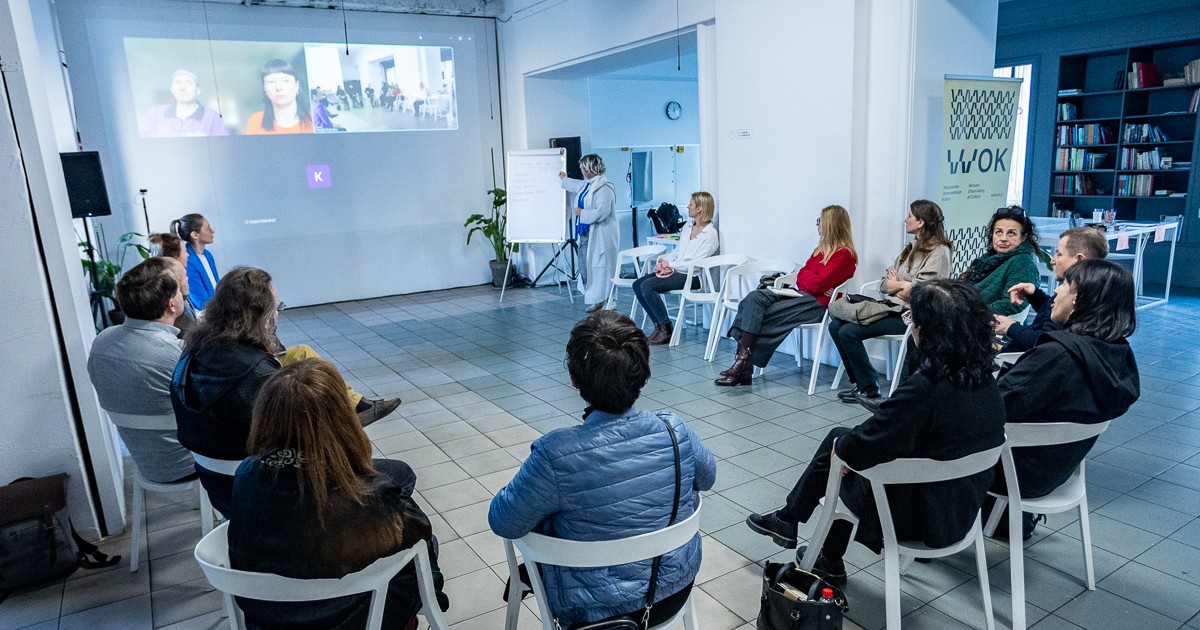
On Friday, 28 November, a meeting was held in Warsaw with representatives from Polish departments, faculties and studios specialising in set and costume design. The meeting primarily focused on consultations related to preparations for the Student Exhibition at PQ 2027. The participants developed recommendations in this area.
As part of the environmental needs assessment conducted prior to the meeting, many important topics and issues were raised the discussion of which was found crucial to the meeting attendees, including the following topics.
– Cooperation of departments, faculties and studios with external entities. How can departments and studios collaborate to enhance the visibility of the set design profession in the future
– Absence of a forum or venue for presenting set design works (apart from the competition for the Best Set Design Diplomas of Artistic Universities in Wrocław). Events such as the Jerzy Moskal Stage Design Award competition and the ‘Scena w Budowie’ (Stage Under Construction) Festival in Lublin are sadly no longer held. These events, organised by institutions independent of the Academy, provided an overview of trends and teaching methods at individual universities, as well as an ideal opportunity for integration for teachers, educators, students, and graduates.
– Broadly understood protection of the profession’s prestige. Raising awareness in the theatre community of the role and skills of professional set designers is an important demand of those working in set design. Set design is a profession that requires technical and intellectual resources, so it is in the interest of the entire theatre community to maintain the status and prestige of this profession.
– The need to present a variety of scenographic trends, both innovative and traditional. This is important because they are both equally prevalent on theatre stages today. Focusing on just one trend would not reflect the current state of Polish scenography.
– A decline in interest among students in pursuing a career in theatre costume design has been observed. According to the survey, this decline is driven by various factors, including the poor treatment of costume designers by institutions and challenging production conditions, such as the closure of workshops, escalating costs in the freelance market, and a shortage of skilled artisans. Nevertheless, costumes are an essential element of every performance.
– Lack of archives. This issue is a significant hindrance to gathering knowledge and presenting the achievements of set designers. There is also a lack of monographs on set designers in Poland.
The meeting was a continuation of the dialogue that began during the study visits to departments, faculties and studios of set and costume design throughout Poland, which have been held since October 2025 when Krystyna Mogilnicka and Karolina Dziełak-Żakowska, from the Theatre Institute’s International Cooperation Department began organising meetings with lecturers. Meetings have so far been held on 2 October at the Performance and Set Design Studio at the Faculty of Architecture and Design in Gdańsk; on 9 October at the Department of Set Design at the Faculty of Interior Design and Set Design at the University of Arts in Poznań; on 14 October at the Set Design Department of the Faculty of Painting at the Academy of Fine Arts in Kraków; on 3 November at the Faculty of Set Design at the Academy of Fine Arts in Warsaw; and on 13 November at the Department of Set Design at the Faculty of Interior Design, Design and Stage Design at the Eugeniusz Geppert Academy of Fine Arts in Wrocław. Further visits are planned for the coming months, including to Katowice and Szczecin.
During these meetings, Institute representatives have had the opportunity to meet the educators of future set and costume designers, familiarise themselves with the departments’ infrastructure and current needs and problems, and learn about the latest trends and developments in these fields.